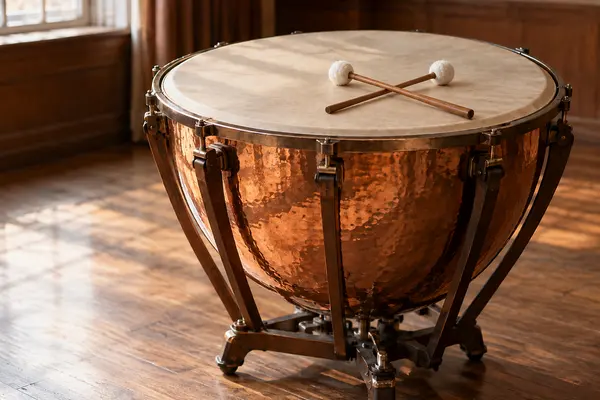
- Tension sets pitch
- Overtones set colour
- Weight can tune them
- Strike, listen, retune
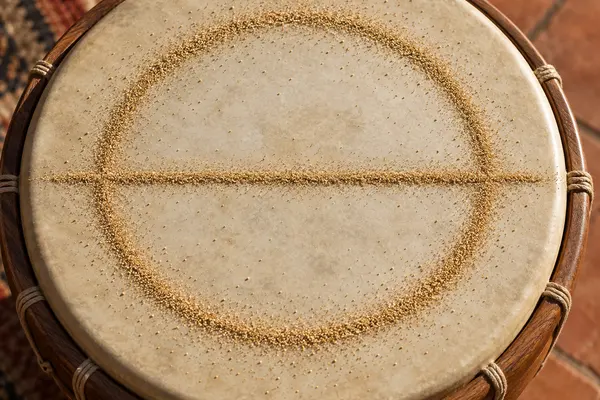
PLAIN HEAD
Why most drums thud
A stretched skin vibrates in many patterns at once, and their frequencies do not line up as harmonics.
See the numbers doodledrum
Updated
THE PHYSICS OF PERCUSSION
Every drum is a stretched skin deciding which notes to keep.
Most drums give a thud, not a note. A few, like timpani and tabla, are built to sing in tune, and the talking drum can bend its pitch mid-phrase. Here is how a drumhead makes its sound, in plain English.
Plain English, with the sources linked.
TENSION sets the pitch
Try the drum check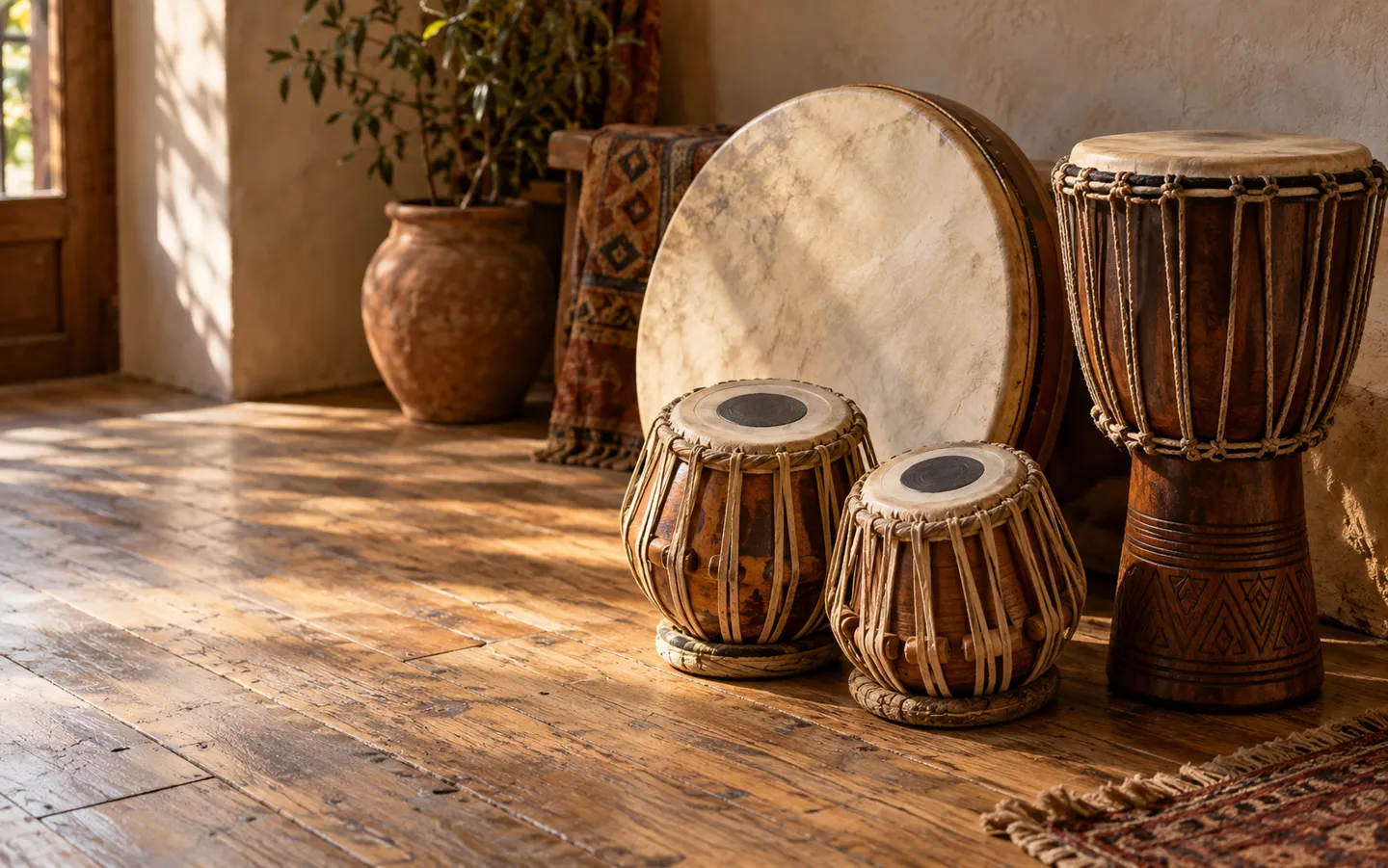
THE SHORT ANSWER
It depends on whether the drumhead's
overtones line up with each other.
PLAIN HEAD
A stretched skin vibrates in many patterns at once, and their frequencies do not line up as harmonics.
See the numbersKETTLE DRUM
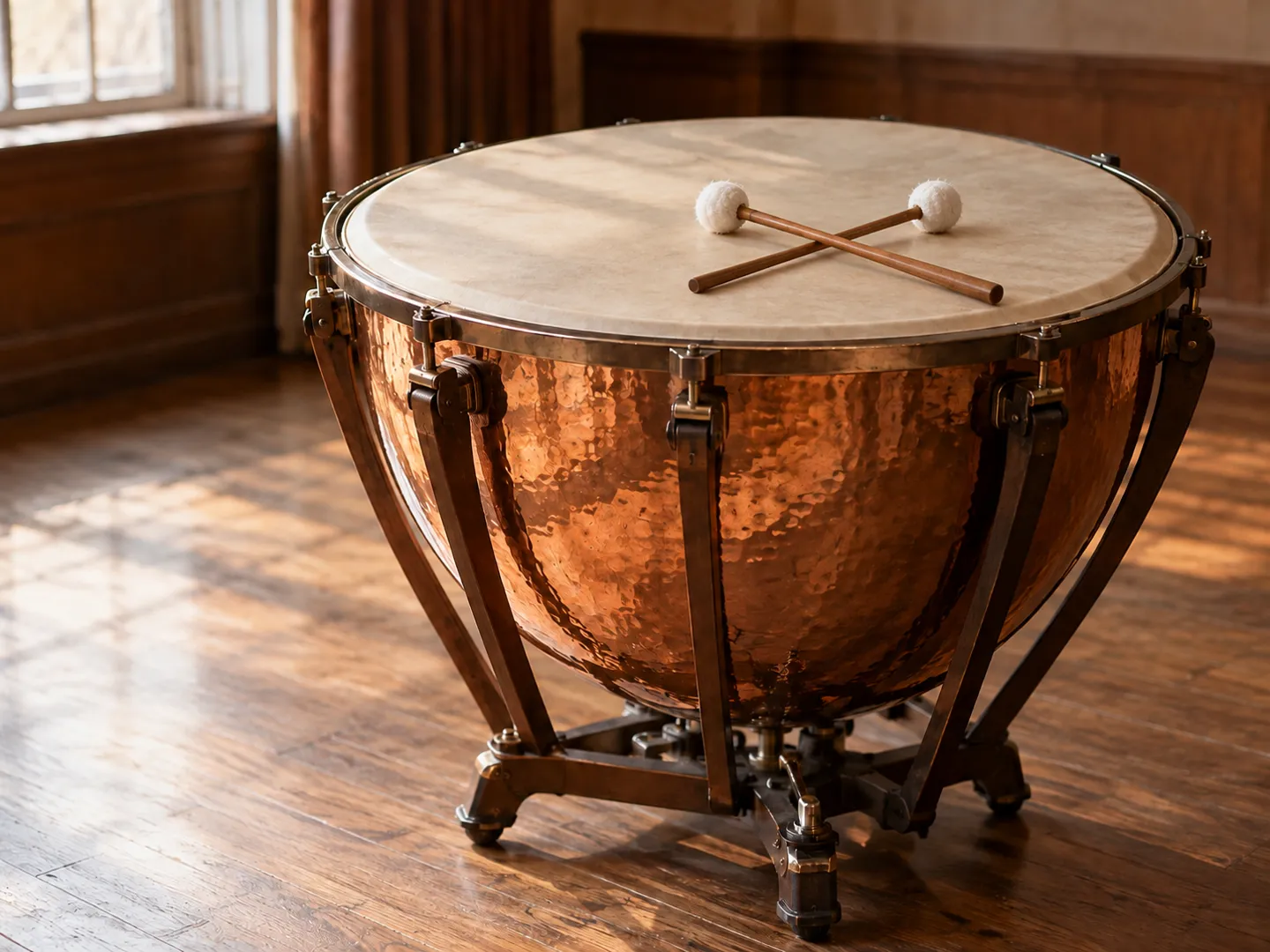
The sealed kettle and the air around the head pull the overtones into line, giving a pitch an orchestra can use.
Listen closerLOADED HEAD
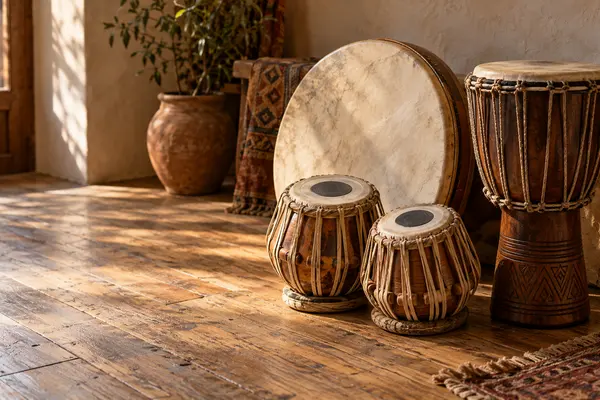
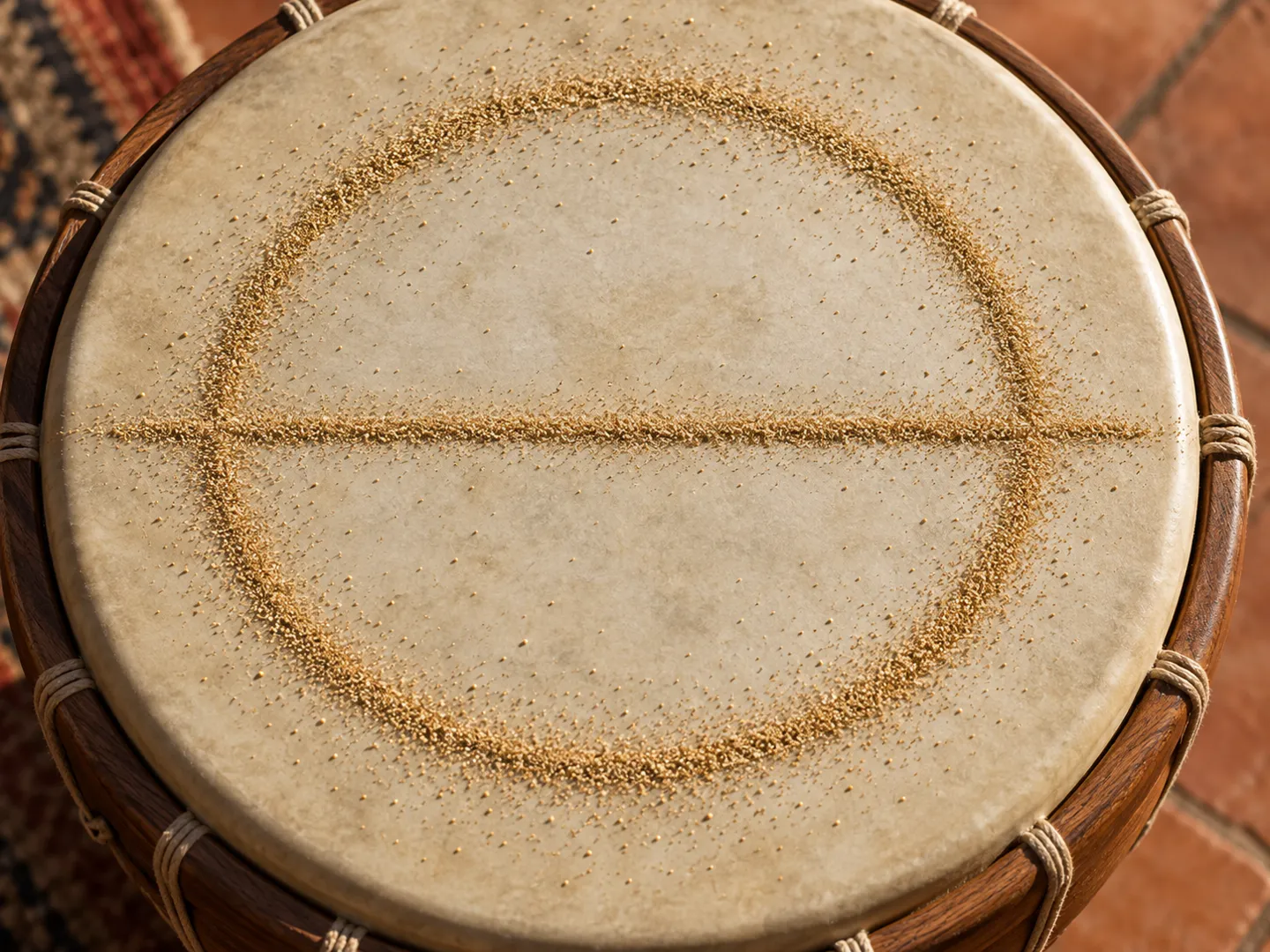
Indian drums such as the tabla carry a weighted central patch that turns their overtones into harmonics.
Read the factsA QUICK DRUM CHECK
Pick a kind of drum to see what its head does with its overtones. The descriptions come from university physics teaching material, a 1920 paper in Nature and a Smithsonian museum record.
No pitch is not a fault. A thud with clashing overtones is exactly what a snare or bass drum is meant to give.
TWO DRUMHEADS COMPARED
Overtones written as multiples
of the lowest frequency.
1 : 1.59 : 2.14 : 2.30
First four vibration modes
An ideal circular membrane's overtones fall at awkward ratios. None is a whole-number multiple of the lowest, so the modes are inharmonic and the drum gives no firm pitch.
PLAIN, EVEN HEAD
1 : 2 : 3 : 4 : 5
Tones the head can give
With a weighted central patch, an Indian drumhead gave five tones in harmonic sequence, counting the fundamental. Raman later described the head dividing into one to five sections to produce them.
LOADED HEAD · RAMAN AND KUMAR, 1920
Raman and Kumar opened their 1920 note by observing that percussion instruments, as a class, give inharmonic overtones. These drums were the exception they set out to explain.
LISTEN CLOSER
Hit a drum dead centre, then part-way to the rim. Timpani players aim about halfway to three quarters of the way out, where the useful modes ring.
Press gently on the head with one hand while tapping with the other. More tension raises the pitch, the same idea the talking drum uses.
On timpani, try to pick out the fifth and the octave sounding above the main note. They are what make it a tuned drum.
Noise adds up. NIOSH sets its limit at 85 dBA over eight hours and halves the time for every 3 dBA more, so long loud sessions count.
DRUM FACTS
Like a string, a drumhead rises in pitch as its tension increases. Its frequencies also depend on its size and on how heavy the membrane is for its area.
On an ideal circular head, the next modes above the lowest sit at about 1.59, 2.14 and 2.30 times its frequency. Physicists call such modes inharmonic.
On timpani the true fundamental is heavily damped and not generally used in music. Players strike about halfway to three quarters of the way out to excite the preferred modes.
Raman and Kumar described the central load on the Indian drumhead as a flexible composition containing finely divided iron, laid unevenly so the head gives harmonic tones.
The Yoruba talking drum mimics the tones and cadence of speech. The player squeezes the ties joining its two heads between arm and torso while striking it with a curved stick.
QUICK QUESTIONS
Short answers to the questions people ask most.
Why does a drum not play a clear note like a guitar?
A plain circular drumhead vibrates in several patterns at once, and their frequencies are about 1.59, 2.14 and 2.30 times the lowest one. Because these overtones are not whole-number multiples, the ear hears a thud rather than a definite pitch.
How do timpani play definite notes?
The head sits over a sealed kettle. The enclosed air and air damping shift the preferred vibration modes into a near-harmonic series, so the drum sounds a main note with a fifth and an octave above it. Its true lowest mode is heavily damped and not used.
What makes the tabla and mridangam sound so musical?
Indian drums of this kind carry a weighted patch on the head. In 1920 C. V. Raman and Sivakali Kumar reported that this loading lets the head give five tones in harmonic sequence, counting the fundamental, much like a string.
How does a talking drum change pitch?
The Yoruba talking drum has two heads joined by cords. The player squeezes the cords between arm and body while striking, which tightens the heads and raises the pitch, letting the drum follow the tones of spoken Yoruba.
How loud is too loud when playing?
The US National Institute for Occupational Safety and Health recommends a limit of 85 A-weighted decibels averaged over an eight-hour day, and halving the time for every 3 dBA increase. Bars and nightclubs often reach 95 dBA or more.
A NAME WITH A BEAT
doodledrum.com is part of the DoodleSale portfolio. It isn't in an auction right now, but you can ask about leasing it.